FTTP: Building the UK’s Digital Future
Why It Matters and How Core Connect Utilities Ltd Delivers
Ready to accelerate your fibre rollout? Contact the Core Connect Utilities team today via our online form at coreconnectgroup.co.uk/contact or phone us direct on 01773 301372. We provide full-turnkey Fibre to the Premises (FTTP) solutions that take projects from blank sheet to commissioned network—safely, on time and on budget.
1. Introduction: A New Era of Connectivity
If the last decade has taught us anything, it is that digital connectivity is no longer a luxury but a lifeline. Remote work, cloud collaboration, virtual classrooms, real-time data analytics, and the proliferation of Internet of Things (IoT) devices have pushed bandwidth requirements far beyond what traditional copper networks can reliably deliver. Fibre to the Premises (FTTP) has emerged as the gold standard for meeting this skyrocketing demand, enabling households and businesses to access gigabit-class speeds with rock-solid reliability. For local authorities, network operators, and private developers striving to future-proof their assets, the question is no longer whether to invest in FTTP, but how quickly it can be deployed.
This article explores why FTTP matters, the technical and commercial benefits it brings, the challenges involved in large-scale roll-out, and how Core Connect Utilities Ltd—an East Midlands-based specialist in end-to-end FTTP delivery—helps clients overcome those challenges every day.
2. What Exactly Is FTTP?
At its simplest, Fibre to the Premises means running fibre-optic cable all the way from the network exchange or street cabinet directly into each individual home or business. Unlike Fibre to the Cabinet (FTTC) solutions—where the final stretch still relies on legacy copper—FTTP removes the “weakest link,” unlocking symmetrical speeds, ultra-low latency, and far greater resistance to interference. Light signals travel through hair-thin strands of glass or plastic at close to the speed of light, carrying tens of terabits of data per second. This capacity is effectively future-proof for decades, limited only by the performance of endpoint electronics, which can be upgraded without digging up streets again.
3. Speed, Latency, and Reliability: The Technical Pay-off
Why does that all-fibre connection matter in practice? First, headline speeds jump from megabits to gigabits per second. Streaming 8K video, operating advanced CAD software in the cloud, or synchronising terabytes of data becomes routine rather than aspirational. Second, latency—often overlooked—drops to single-digit milliseconds, critical for real-time applications such as cloud gaming, autonomous vehicles, industrial automation, and tele-medicine. Third, fibre is immune to electromagnetic interference and less vulnerable to weather-related degradation, meaning fewer faults, lower maintenance costs, and happier end-users who spend less time talking to help-desks.
4. Economic and Social Impact
FTTP is more than a technical upgrade; it is a catalyst for economic growth. Research by the FTTH Council Europe indicates that regions with high fibre penetration see measurable uplifts in GDP, employment, and property values. For rural communities, gigabit connectivity can reverse the talent drain by enabling remote work opportunities equal to those in London or Manchester. For city-centre landlords, fibre enhances commercial rental yields and tenant retention. Local authorities benefit from the digital infrastructure needed for smart-city services—traffic monitoring, environmental sensors, and emergency response systems—while residents enjoy seamless e-government interactions.
5. Barriers to Large-Scale FTTP Roll-out
Despite its clear benefits, deploying FTTP nationally is no small feat. Civils works must navigate congested high streets, protected heritage zones, and disparate local-authority permitting processes. Accurate topographical surveys are crucial to avoid utility strikes. Build partners need well-trained crews who can handle horizontal directional drilling (HDD), pole erection, micro-trenching, and fibre splicing. Meanwhile, programme managers juggle supply-chain logistics, stakeholder communications, and strict health-and-safety legislation. Cost overruns and delays can quickly erode the business case if these complexities are not expertly managed.
6. Core Connect Utilities Ltd: End-to-End Expertise
Founded to meet the UK’s surging demand for full-fibre networks, Core Connect Utilities specialises in providing turnkey FTTP delivery—from initial planning to final commissioning. Our multidisciplinary teams combine civil engineering, fibre design, build, and network activation under one roof, reducing hand-offs and accelerating time-to-service. Leading operators such as Openreach partners, Morrison Telecom Services, and MAP Group trust us as their delivery arm because we deliver measurable results: fewer defects, higher first-time-right rates, and tighter schedule adherence.
Key differentiators include:
• Collaborative design approach: We engage stakeholders early, using GIS-driven route planning and desktop surveys to minimise excavation and streamline permitting.
• Specialist civils crews: Our engineers handle everything from traditional trenching to narrow-slot micro-trenching and no-dig solutions, backed by robust reinstatement standards that keep local highways authorities on side.
• Integrated fibre teams: Splicers, testers, and commissioning engineers work hand-in-glove with civils crews, ensuring seamless hand-over from duct to light.
• Data-driven programme management: Real-time dashboards track productivity, quality metrics, and safety observations, giving clients clear visibility and control.
7. Civil Engineering: The Foundation of Any FTTP Build
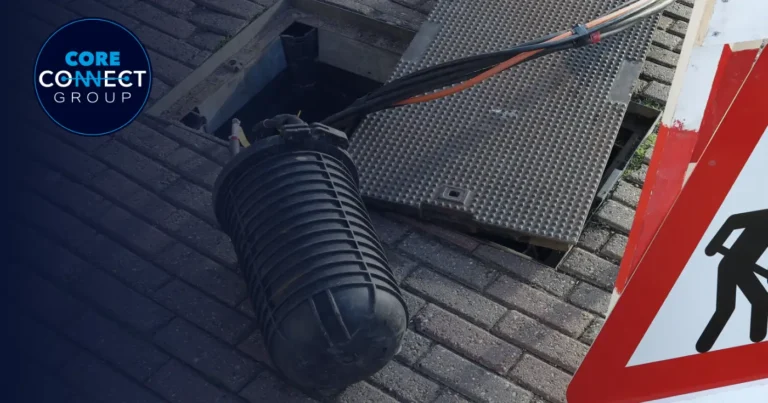
Civil engineering is often the most time-consuming and expensive element of an FTTP rollout. Core Connect Utilities delivers a full suite of civil works, including open-cut, narrow-trench, and HDD installations, plus carriageway and footway reinstatement compliant with the Specification for the Reinstatement of Openings in Highways (SROH). Our crews prioritise minimal disruption, working night shifts or utilising modular duct systems where appropriate. Because we maintain in-house traffic management capabilities, we fast-track permitting and reduce third-party dependencies—helping clients hit aggressive build targets without compromising safety or quality. For more detail, see our dedicated civil-engineering service overview civil-engineering.
8. Network Delivery: Lighting the Fibre
Once the physical path is built, the next step is blowing, splicing, and testing the fibre backbone. Our network-delivery division takes ownership of these tasks, integrating seamlessly with Tier-1 vendors’ design packs. Engineers employ calibrated fusion splicers, OTDR testing, and live PON monitoring to guarantee attenuation performance well within spec. Because all our fibre staff are directly employed and certified, we maintain tight control over training standards and safety culture. The result is a network that performs from day one, ready for operator acceptance and end-customer activation—often weeks faster than industry averages Network Delivery.
9. Quality, Compliance, and Safety
Regulatory compliance is a non-negotiable pillar of our operating model. Core Connect Utilities adheres to ISO-accredited management systems for Quality (9001), Environmental (14001), and Occupational Health & Safety (45001). Daily site audits and digital toolbox talks reinforce best practice, while our near-miss reporting app empowers field teams to raise concerns instantly. This culture of continuous improvement not only protects our people and the public; it also safeguards client reputations and ensures smooth interactions with local authorities and residents.
10. Case in Point: Accelerating Build in the East Midlands
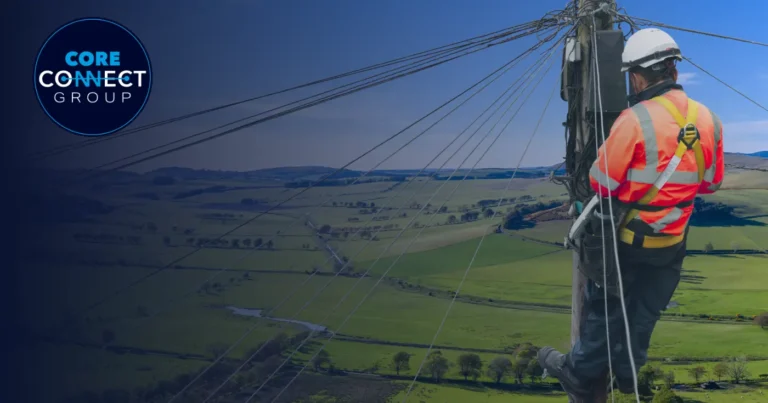
When a national network operator needed to bring gigabit connectivity to 18,000 premises across Derbyshire, they engaged Core Connect Utilities for full-turnkey delivery. By deploying a hybrid build strategy—combining existing ducts, narrow-slot micro-trenching along rural lanes, and aerial fibre on wooden poles—we completed the civils scope six weeks ahead of schedule. Our integrated fibre crews achieved first-time-right splice rates above 97 percent, reducing additional truck rolls and enabling an earlier customer-go-live date. Local councillors praised the minimal traffic disruption, and the operator has since expanded our remit into neighbouring counties.
11. The Road Ahead: Smart Cities and Beyond
While today’s FTTP deployments focus on gigabit broadband, tomorrow’s networks will underpin autonomous transport systems, edge-compute micro-data-centres, and ultra-high-definition holographic conferencing. That future demands not just capacity but resilience and adaptability. Core Connect Utilities is investing in new methodologies—such as use of recycled polymer ducting, AI-driven defect detection, and modular passive optical network (PON) architecture—to ensure that fibre infrastructure installed today can scale effortlessly to meet next-decade requirements. We believe collaboration between network operators, local authorities, and delivery specialists will be crucial to turning the UK’s digital ambitions into reality.
12. Conclusion: Partner with the FTTP Experts
FTTP is the backbone of the modern economy, unlocking speed, reliability, and innovation far beyond the limits of copper. Yet delivering fibre at scale demands a partner that understands the full life-cycle—from initial route design to final light-on. Core Connect Utilities Ltd brings that end-to-end capability, backed by proven field performance, robust quality systems, and an unwavering commitment to safety.
Get your project off the ground today. Reach us via the online form at coreconnectgroup.co.uk/contact, phone: 01773 301372 email: contact@ccu-ltd.co.uk, or write to our head office at:
Core Connect Utilities Ltd
The Old Chapel
Market Street
South Normanton
Derbyshire
DE55 2AB.
Let’s build the full-fibre future—together.